What the Browser Wars Left Behind —
30 Years of Rivalry That Shaped the Web We Build Today
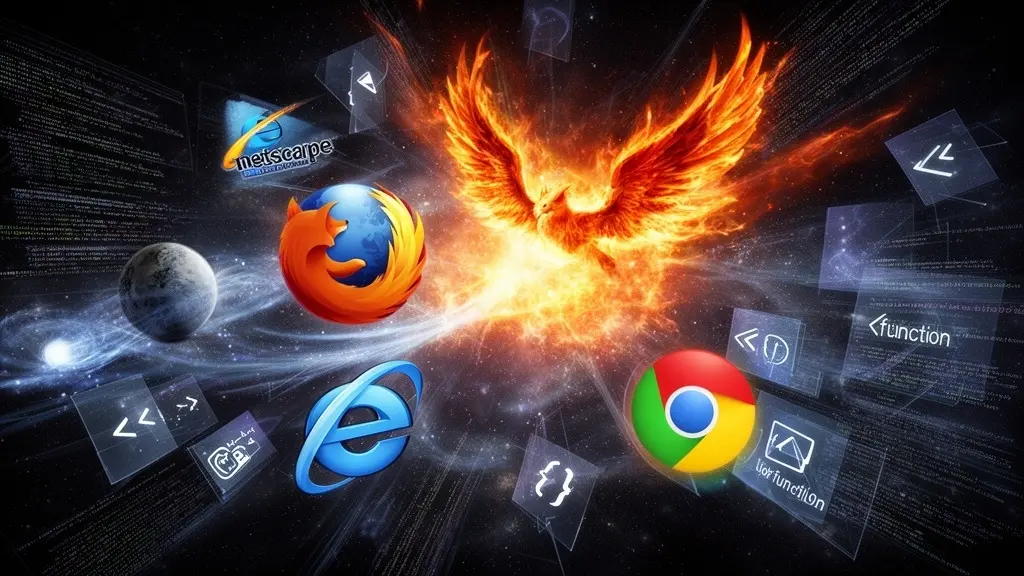
Every line of CSS you write, every JavaScript API you call, carries the fingerprints of a three-decade power struggle. Netscape's rise and fall, Microsoft's monopoly, Firefox's rebellion, Chrome's takeover — the browser wars didn't just decide which icon you click. They decided what the web itself became.
"It Doesn't Matter Which Browser You Use" — Does It?
Open Chrome. Load a website. That's normal now — so normal that most people never think about it. Chrome holds somewhere between 65% and 70% of the global desktop market. On mobile, the dominance is even starker. Choosing a browser feels like choosing a brand of bottled water: the differences seem negligible.
But "every browser renders the same page the same way" is a very recent luxury. Fifteen years ago, web designers spent hours rewriting CSS just to make things look right in Internet Explorer 6. Twenty years ago, front-end engineers wrote two separate versions of JavaScript — one for Netscape, one for IE. And before that, the concept of a "web browser" didn't exist at all.
The history of the browser is the history of the web. Whichever browser held power got to define what "normal" meant for everyone building on it.
If you've ever wondered why document.getElementById() is so verbose, or why you need to explicitly set box-sizing: border-box, the answers live inside the browser wars. These aren't random design choices — they're scars from thirty years of competition, compromise, and standardization.
The Spark — When Mosaic Put Pictures on the Web
In 1991, Tim Berners-Lee released the world's first web browser, called "WorldWideWeb," at CERN. It ran only on NeXT computers. It displayed text and hyperlinks, nothing more. The web existed, but it was a tool for particle physicists, not a medium for the world.
The turning point came in 1993. At the University of Illinois, inside the National Center for Supercomputing Applications (NCSA), a 21-year-old undergraduate named Marc Andreessen and his colleague Eric Bina released NCSA Mosaic. Its innovation was deceptively simple: images displayed inline with text. Not in a separate window. Right there on the page, next to the words.
That was it. That single change cracked the web open. Within months, Mosaic was being downloaded over 5,000 times a month. Researchers, hobbyists, and curious newcomers suddenly saw the web not as an academic network, but as something visual, something alive. "The web is for everyone" stopped being a philosophy and became a feeling — the feeling of loading a page and seeing a photograph appear.
In 1994, Andreessen left NCSA and co-founded Mosaic Communications Corporation with Silicon Valley entrepreneur Jim Clark. The company was soon renamed Netscape Communications, and its flagship product — Netscape Navigator — would conquer the web at a speed the tech world had never seen.
The First Browser War — Netscape vs. Internet Explorer
By mid-1995, Netscape Navigator owned more than 80% of the browser market. Netscape wasn't just a software company. Its CEO Jim Barksdale declared that the browser would become the new operating system — a platform that could render Windows irrelevant. When Netscape went public in August 1995, its stock price more than doubled on the first day of trading. The dot-com era had its poster child.
Netscape declared that the browser would replace the OS. For Microsoft, that wasn't a prediction — it was an existential threat.
Bill Gates noticed. In May 1995, he circulated an internal memo titled "The Internet Tidal Wave," declaring the internet Microsoft's top strategic priority. The company had already licensed the Mosaic codebase from Spyglass to build Internet Explorer. Now, Gates made the move that would define the war: IE would be bundled with Windows 95 and distributed free of charge.
The first browser war had begun.
Marc Andreessen and Eric Bina create the first popular graphical browser with inline image display. Over 5,000 downloads per month within weeks of release.
Andreessen and Jim Clark found Netscape Communications. Navigator captures the market at breathtaking speed, reaching 80%+ share by the following year.
Microsoft bundles Internet Explorer with its dominant operating system, making it free and pre-installed on virtually every new PC sold worldwide.
Brendan Eich at Netscape designs JavaScript in just 10 days. Microsoft responds with its own implementation, JScript. Two incompatible "JavaScripts" begin coexisting — and the fragmentation headache begins.
The W3C publishes CSS Level 1, separating style from structure. But browser implementations are wildly inconsistent — almost no browser renders the spec correctly.
Facing defeat, Netscape releases its source code to the public. The Mozilla Project is born — a decision that will bear fruit six years later with Firefox.
Shipped with Windows XP, IE 6 becomes the undisputed ruler of the web. Netscape is effectively dead. But IE's dominance will bring its own kind of damage.
The Netscape-IE rivalry pushed web technology forward at a chaotic pace. JavaScript was born because Netscape wanted interactivity. CSS emerged because the W3C wanted to separate content from presentation. <frame>, <blink>, <marquee> — both browsers shipped proprietary tags in a race to out-feature each other. The era was messy, but it expanded what the web could do in ways that a cleaner, slower process never would have.
The ending, though, was brutal. Microsoft wielded Windows — pre-installed on nearly every PC on Earth — as a distribution weapon that no standalone browser company could match. In 1998, AOL acquired the struggling Netscape. That same year, Netscape made a desperate, visionary decision: it open-sourced its browser code. The Mozilla Project was born. It looked, at the time, like a footnote. It turned out to be a seed.
The Dark Age — What IE's Monopoly Did to the Web
By 2001, Internet Explorer 6, shipping with Windows XP, held over 90% of the browser market. The war was over. Microsoft had won. And then something predictable happened: with no competitor left to push against, Microsoft stopped pushing. The gap between IE 6 and IE 7 was five years — five years of near-zero progress in browser technology.
Monopoly kills innovation. For the five years that IE held 90% of the market, browser evolution flatlined.
When I started building websites, the daily reality was fighting IE 6 bugs. Use float for layout and watch your columns collapse. Try a transparent PNG and get a gray background instead. Set a width and discover IE calculated it differently from every other browser. "IE 6 compatibility" wasn't a line item in a project plan — it was the project plan.
No major IE update for five years. CSS 2 implementation remained incomplete. ActiveX became a breeding ground for security exploits. Developers didn't build for the web — they built for IE.
Firefox 1.0 ships with tabbed browsing, pop-up blocking, and genuine standards compliance. It proves that an alternative exists, reignites the browser market, and forces Microsoft back into development with IE 7.
The IE dark age left permanent marks on web development. Why did box-sizing: border-box become a universal reset? Because IE's box model and the W3C's box model calculated width differently. Why did jQuery become the most popular JavaScript library in history? Because the API differences between browsers were so severe that developers needed an abstraction layer just to get anything done. Many of the tools and conventions we take for granted today were born as painkillers for the IE era.
The Second Browser War — Firefox's Rebellion and Chrome's Entrance
In November 2004, Mozilla Firefox 1.0 arrived. Born from the ashes of the Mozilla Project — itself born from the ashes of Netscape — Firefox was an explicit rejection of everything IE stood for. It had tabbed browsing. It had extensions. It had a pop-up blocker. And above all, it took web standards seriously. The message was clear: you have a choice.
Firefox's market share climbed past 20%, enough to wake Microsoft from its five-year slumber. IE 7 shipped in 2006. IE 8 followed in 2009, finally making a real effort at standards compliance. Meanwhile, Apple's Safari and its WebKit engine were quietly building the foundation for mobile browsing — a shift that would soon reshape everything.
Then, in September 2008, Google released Chrome.
Chrome's impact was visceral. Its V8 JavaScript engine was so fast it made everything else feel sluggish. Startup was instant. Page loads were faster. And if one tab crashed, the others survived, thanks to a multi-process architecture that isolated each tab in its own sandbox. Chrome didn't just compete with existing browsers — it redefined what a browser was supposed to feel like.
Chrome wasn't a faster browser. It was a redefinition of what a browser should be — and every competitor had to rebuild to match it.
V8's impact rippled far beyond the browser window. In 2009, Ryan Dahl took the V8 engine and ran it on the server, creating Node.js. JavaScript was no longer a front-end-only language. React, Angular, Vue — the modern front-end framework ecosystem exists because V8 proved that JavaScript could be genuinely fast. Without Chrome, the JavaScript-everywhere world we live in might never have materialized.
By 2012, Chrome had overtaken IE as the world's most-used browser. It hasn't relinquished that position since.
The New Monopoly — Chromium's Dominance and History Repeating
In 2026, Chrome's browser share hovers around 65–70%. But the real story isn't Chrome's market share alone. It's the spread of Chromium — Chrome's open-source foundation — and its Blink rendering engine into nearly every corner of the browser landscape.
In 2019, Microsoft abandoned its own engine and rebuilt Edge on top of Chromium. Opera, Vivaldi, Brave, Samsung Internet — the vast majority of significant browsers now run on Chromium under the hood. The only holdouts with independent rendering engines are Apple's Safari (WebKit) and Mozilla's Firefox (Gecko). Browser engine diversity has never been thinner.
IE 6 holds 90%+ share. Its proprietary features become de facto standards. Web standards stagnate. Browser innovation halts for five years.
Chromium/Blink powers over 75% of all browsers. Chrome, Edge, Opera, and Brave all share the same rendering core. Engine diversity is at an all-time low.
In 2020, the U.S. Department of Justice sued Google for monopolizing the search market and initially sought a forced sale of Chrome. The September 2025 ruling stopped short of a divestiture, but it banned Google from signing exclusive default-search deals — the very mechanism that had cemented Chrome's distribution advantage. A quarter-century after the Microsoft antitrust case, the browser monopoly question was back in a federal courtroom, wearing different clothes but posing the same threat.
There are real differences between the IE era and now, of course. Chromium is open-source. Anyone can read the code, fork it, build on it. That's fundamentally unlike IE's closed ecosystem. But open-source doesn't mean open governance. Google employs the majority of Chromium's core contributors. Google decides which features land and which get removed. The code is visible to everyone; the roadmap is shaped by one company. Transparency is not the same as neutrality.
What the Wars Left on the Battlefield
Zoom out across thirty years of browser conflict and one pattern becomes clear: whoever controls the dominant browser controls the trajectory of web technology. Not formally, not through a standards body, but through sheer gravity — the gravity of market share.
If Netscape hadn't needed a scripting language to make web pages interactive, Brendan Eich would never have designed JavaScript in ten frantic days. If IE hadn't monopolized the market with its buggy, inconsistent rendering, jQuery and Modernizr would never have needed to exist. If Firefox hadn't championed web standards, CSS 3 and HTML5 might have taken years longer to materialize. If Chrome hadn't proven that JavaScript could be fast, Ryan Dahl would never have imagined Node.js, and the entire modern front-end stack — React, webpack, Vite, Next.js — might look completely different.
Every line of HTML, CSS, and JavaScript you write sits on top of a battlefield. The browser wars didn't just pick winners — they shaped the code we all write today.
Knowing this history matters because it transforms confusion into understanding. The next time a CSS property behaves in a way that seems arbitrary, or a JavaScript API feels needlessly verbose, pause for a moment. Behind that quirk, there's almost certainly a story — a story about Netscape and IE trading blows in the 1990s, about developers duct-taping layouts together during the IE 6 era, about Chrome's V8 rewriting the rules in the 2010s.
The web you build on today is not the product of clean, rational design. It's the accumulated result of thirty years of competition, compromise, breakage, and repair. The next time you open DevTools, remember: you're standing on a battlefield. The fighting shaped the ground beneath your feet — and it isn't over yet.
Takeaways
- NCSA Mosaic's 1993 innovation — displaying images inline with text — ignited the popularization of the web, and Netscape Navigator turned the browser into a mainstream product almost overnight.
- Microsoft's strategy of bundling IE with Windows destroyed Netscape and delivered 90%+ market dominance, but that monopoly froze browser innovation for five years.
- jQuery, CSS resets, and countless developer workarounds were born as direct responses to the pain of IE-era browser inconsistencies — tools we still feel the influence of today.
- Firefox revived the importance of web standards, and Chrome's V8 engine unlocked JavaScript performance that made Node.js and the modern framework ecosystem possible.
- In 2026, Chromium/Blink powers over 75% of all browsers. The monopoly risk has returned in a new form, and the survival of rendering-engine diversity will shape the next thirty years of the web.